Systematic fair value: where assets trade versus cross-market drivers
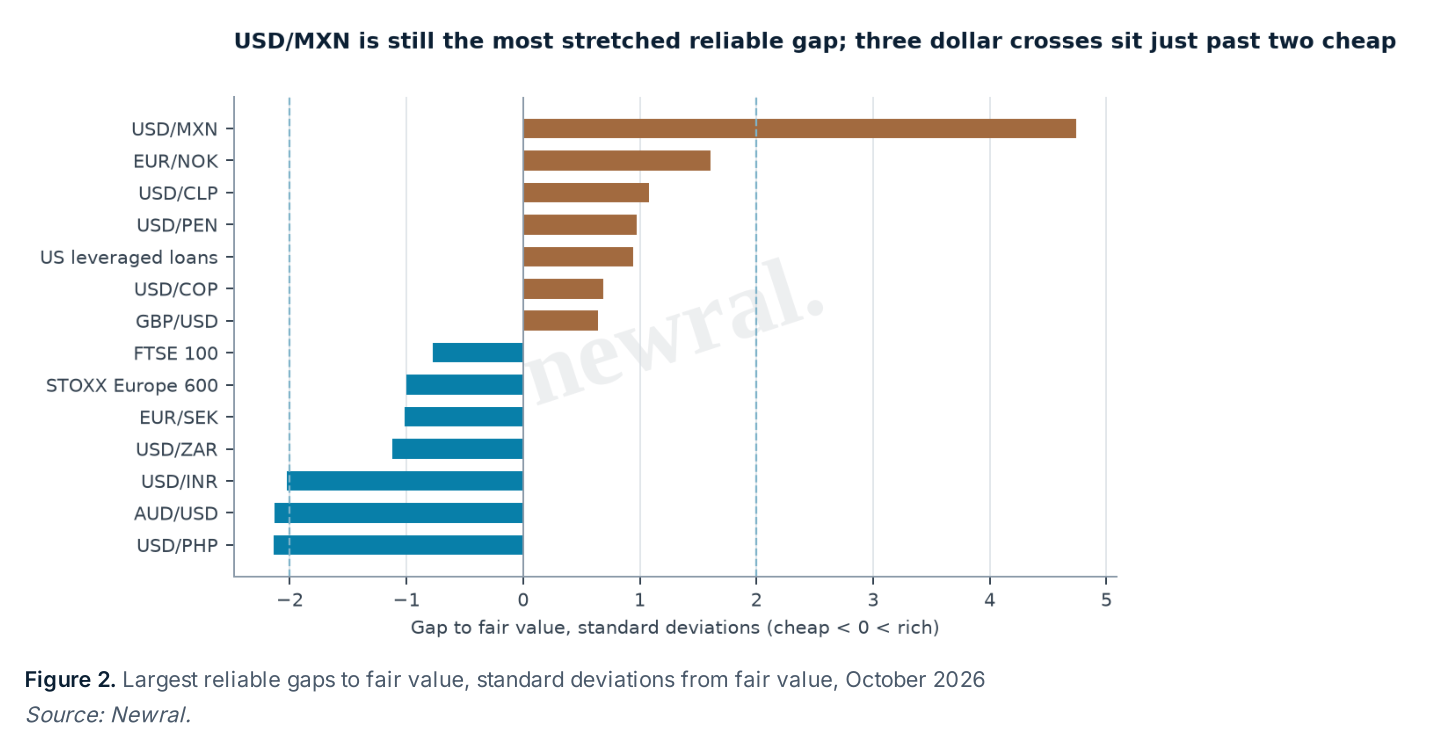
Systematic fair value is an estimate of where an asset should trade given the forces that move markets as a whole. Newral's model estimates fair value for more than 80 assets across asset classes and flags those trading outside their normal range as rich or cheap, but only when the model has enough confidence in the relationship to rely on it.
The question it answers
Which assets are trading furthest from where cross-market relationships say they should be, and is that relationship reliable enough to put on the research list?
How it works
The model reads daily prices across equity indices, currencies, government bonds, credit and commodities. Newral's proprietary approach estimates where each asset would trade if it were priced in line with the broader cross-asset market, rather than judging it only against its own past. The gap between the market price and that fair value is then compared with the asset's own history, which defines a normal range around fair value. Before a reading counts as an active signal, the model applies a set of confidence checks on how reliable the relationship has been. If they are not met, confidence is switched off and no rich or cheap reading is made, so the shortlist only contains dislocations the model can stand behind. Every estimate is built only from information available at the time, and fair value is shown on trading, macro and cyclical horizons, with the macro view as the primary one.
What you see in the portal
- Spot price and fair value for each asset, with the normal range shaded around fair value
- Signal pressure: the standardised distance from fair value, positive when rich and negative when cheap
- An active shortlist of rich and cheap assets that pass the confidence checks
- A confidence state for every asset (active signal, inside band or confidence off) with a plain-English reason
- A full-universe scanner covering every asset in the model
How clients use it
- Build a research queue from the largest dislocations instead of screening dozens of assets by hand.
- Cross-check a valuation view on a currency, index or commodity against the rest of the market.
- Separate dislocations backed by a stable relationship from noisy ones before committing analyst time.
Frequently asked questions
- What is systematic fair value?
- Systematic fair value is the price an asset would have if it traded in line with the wider cross-asset market. The difference between the market price and that estimate shows whether the asset is rich or cheap relative to the rest of the market, rather than relative to its own past alone. Newral flags a reading only when the model has confidence in the relationship.
- What does confidence off mean in a fair value model?
- Confidence off means the model does not consider the relationship between an asset and the wider market reliable enough right now to support a rich or cheap reading. Newral still shows the estimate for transparency, but the asset does not appear on the active shortlist until the model regains confidence in it.
- What is the normal range in a fair value chart?
- The normal range is the band around fair value within which the price usually trades, based on the asset's own history. Inside the band, the asset is broadly in line with the market. A move outside it marks a dislocation worth investigating. Assets can stay dislocated for long stretches, so a reading outside the band is a starting point for research rather than a trading instruction.
- Which assets does the fair value model cover?
- The model covers more than 80 liquid assets across equity indices, currencies, government bonds, credit and commodities, so a currency can be compared with equities, rates and commodities on the same footing. Fair value is estimated on trading, macro and cyclical horizons, which helps separate short-term noise from medium-term dislocations.