Weekend Editorial ·
AI is now spending other people's money
Meta's new shares and debt made AI a financing story, and the 10-year yield fell 15bp on a day Brent closed near $113.
Meta reported record revenue on Wednesday evening, up 26% on a year earlier, but most of the attention went to how it plans to pay for its AI ambitions. It raised its 2026 capital spending outlook to between $135bn and $145bn, its free cash flow for the quarter was negative by about $2.1bn, and it announced a new class of non-voting shares, which it says will give it "the ability to finance its growth".
Bonds rallied while oil went up
The market's verdict on Thursday was harsh. Meta's stock fell 7%, the Nasdaq 100 lost 2.9% and the S&P 500 1.2%. At the same time Treasuries had their best day in more than a year, and the 10-year yield fell 15bp to back below 5%.
What surprised us was that this happened while Brent closed near $113, its highest level of the week. Since the Fed hiked in September, a rise in oil like that would normally have pushed yields higher, because the bond market was mostly worried about inflation and government borrowing. On Thursday it seemed far more interested in what was happening to tech stocks.
Why one company's funding matters
For most of the AI boom, the largest technology companies paid for their data centres out of profits. If the spending disappointed, the damage stayed with their own shareholders. Meta is now in a different position, because it is investing more than its business brings in. It borrowed $25bn in May, and one estimate has it raising more than $40bn through shares and convertible bonds.
Once lenders and new shareholders are carrying part of the risk, a disappointment in AI is no longer just about one share price. It becomes a question of how much credit the build-out will need and on what terms, and in the end that is a question about growth. We think this is how a change in one company's share structure found its way into the Treasury market.
Bonds are useful again
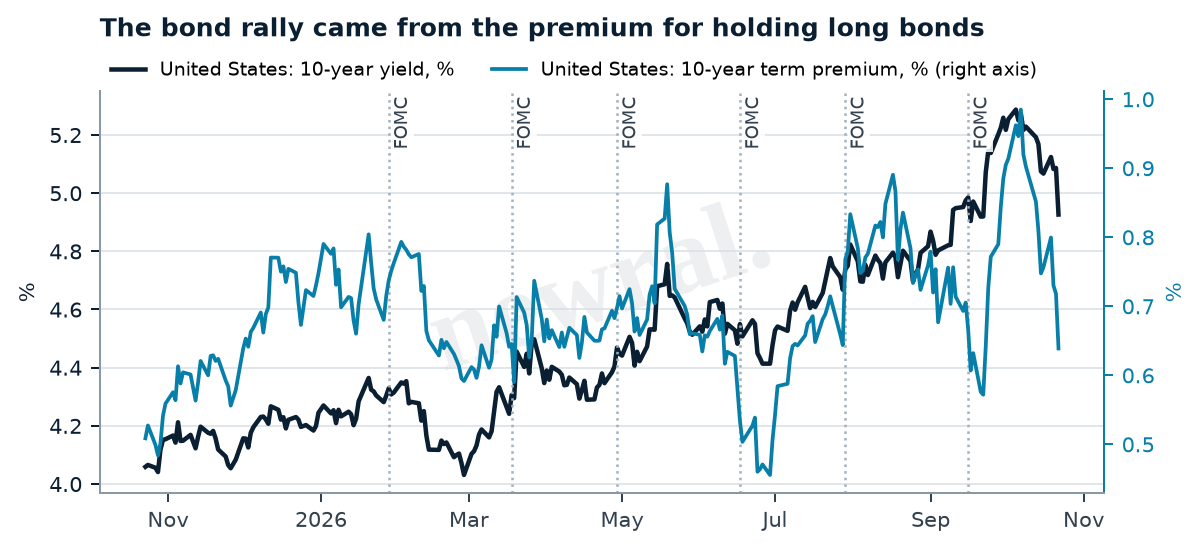
Investors usually want some extra yield, the term premium, for holding long bonds, and they want more of it when bonds tend to fall at the same time as stocks. When bonds rise during a sell-off, they work as insurance and investors are willing to accept less. Our estimate of the term premium was the main reason the 10-year yield climbed above 5% in September. Since then the yield has fallen about 30bp, and roughly 26bp of that has come from the term premium, which is now 0.64%. Expectations for the Fed have hardly moved. What has changed is how investors value bonds in a portfolio.
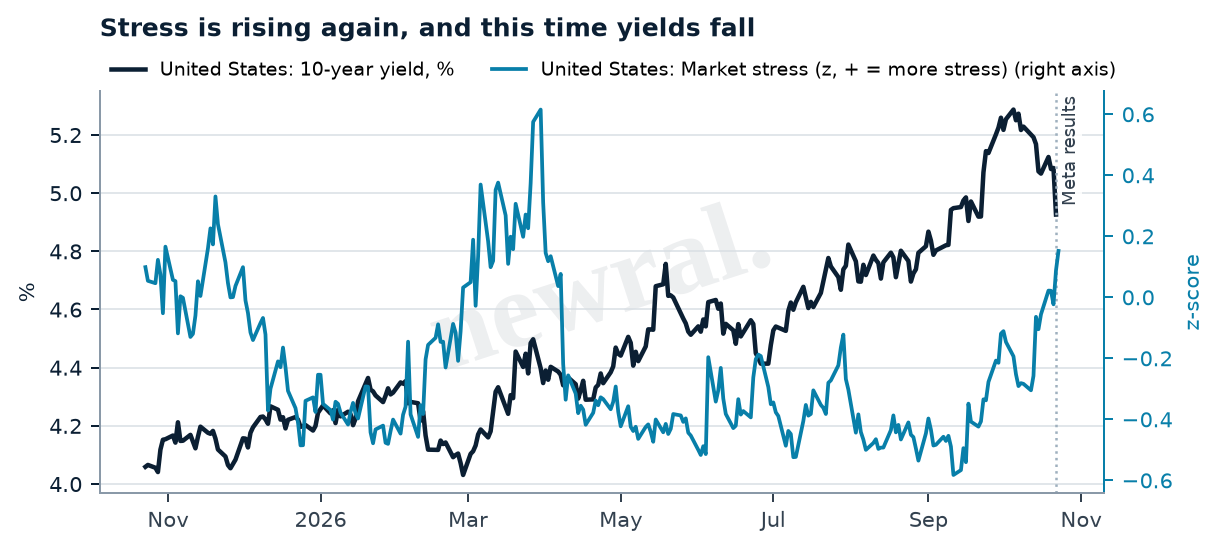
Our gauge of US market stress points the same way. From the September hike to mid-October, stress and the 10-year yield rose together, which is what you would expect during an inflation scare. Since then stress has kept rising while yields have fallen, which looks much more like worry about growth.
What could change this
We are not sure this lasts. With oil above $110, inflation could easily take charge of yields again. For now our nowcasts show headline inflation running well above core, which is mostly fuel, while core inflation is rising at a steady pace. If higher fuel costs start to feed into core prices, we would expect bonds to stop protecting stocks fairly quickly.
It is also worth saying that the economy itself still looks reasonably healthy. Our economic models see the likelihood of a US recession over the next 12 months at close to 0%. The bond market seems to be worrying about something further out, namely that financing the AI build-out could tighten credit enough to slow growth later on.
Next week should tell us more. The Fed meets, several of the other large tech companies report, and the first estimate of third-quarter GDP comes out. The thing we will be listening for in the results is whether the others are also planning to fund more of their spending with debt or new shares. If they are, we would expect Treasuries to keep acting as a hedge for equity investors for a while yet.
Newral content presents model-derived estimates for research and information purposes only and is not investment advice or a recommendation to buy or sell any security or instrument.
Newral's research is built on its own economic and market models. Software tools, including AI, support parts of the production process. Every piece is reviewed and approved by Newral before publication, and Newral AG is responsible for its content.
Get the Weekend Editorial every Saturday
One idea from our models each weekend, free.
Request a sample note