The Long Division ·
AI meets the price of time
On Wednesday evening Alphabet reported results that investors found wanting, and over the next two days the selling spread across technology shares in unison and pulled the big US indices sharply lower. Beneath the indices the damage had started well before, with many of the companies tied to the AI build-out already a long way off their highs when the results season began. The same Wednesday the Federal Reserve left its policy rate at 3.75% to 4%, six weeks after raising it, and two of its voting members dissented because they wanted another increase. By Friday the question on every trading floor was whether this is the first inning of a dotcom repeat or a healthy reset of expectations that had run too far.
Two stories about one sell-off
The dotcom story is easy to tell, because the outline fits. A new technology arrives that really will change how business is done, investors pay for that future years in advance, companies spend heavily to build capacity ahead of demand, and at some point the bill for all that capacity arrives before the revenue does. When it does, the shares fall together, because they were all priced on the same hope.
The reset story is just as reasonable. The companies at the centre of the AI trade are profitable, they fund much of their spending from their own cash, and a quarter in which results fall short of very high hopes says more about the hopes than about the business. On this telling, a few weeks of selling are what it looks like when a crowded trade thins out.
We lean towards the reset, but our reason is different from the one usually given, and it tells us something about how long the reset may last. Both stories treat this as a question about AI, about whether the spending will pay off. We think the bigger force this autumn has been the price of money over time, which has risen all year and which falls hardest on exactly the kind of company the AI trade is made of.
Distant profits are priced off real rates
A share is a claim on profits a company will earn in the future, and its price today is what those future profits are worth now. Money in ten years is worth less than money today, and how much less depends on the real interest rate, the return a saver can earn after inflation. Economists sometimes call the real rate the price of time, because it is what you are paid for waiting.
When the price of time rises, every future profit is worth less today, but the effect grows with distance. A company whose value comes from this year's earnings barely notices. A company whose value rests on profits expected a decade or more from now, from products that are still being built, loses a great deal, because each of those distant years is marked down again and again.
That is a fair description of the AI trade. Investors have valued these companies on what the technology will earn once it is everywhere, which puts much of their value a long way out. The same arithmetic that made them soar when money was cheap makes them the most sensitive shares in the market when it is not, and it explains why they sell off together. They do not need to share customers or suppliers to fall in unison when they share a discount rate.
The price of time has risen all year
Since the end of October last year the yield on 10-year inflation-protected Treasuries, the real yield, has risen 85bp, while the inflation that bond markets price for the next ten years has risen 5bp. Almost all of the rise in long-term borrowing costs has been a rise in the real price of money, and very little of it has been investors asking for protection against inflation.
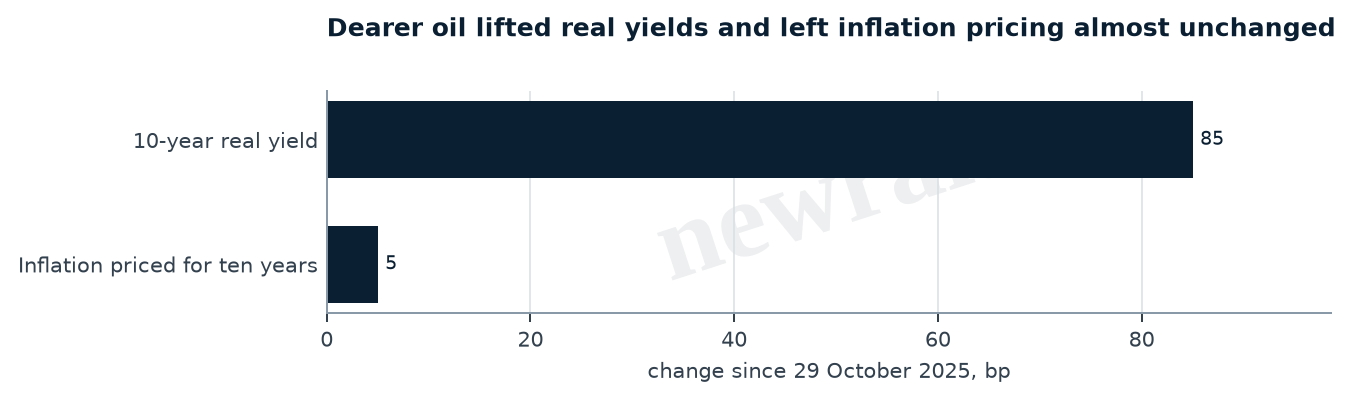
On our reading of US financial conditions, the 10-year real rate is the single tightest input, at about 2.4 standard deviations above its historical average. For comparison, in March 2022 the 10-year real yield was around minus 1%. A saver was then paid less than nothing for waiting, and a company promising profits far in the future lost little by making investors wait for them.
Part of the reason the price of time has climbed is oil. Brent closed on Friday near $112, our nowcast has US headline inflation at 3.9%, and the Fed responded with a hike in September and a statement this week that "inflation remains elevated". The two dissenters, Lisa Cook and Beth Hammack, wanted to raise rates again, and markets put 73% on another hike in December.
This is where the Fed comes into the AI story. In past sell-offs investors in technology shares could count on the central bank to cut rates if falling markets threatened the economy. This Fed is worried about inflation, and our nowcast of core inflation, at 2.8%, gives it little reason to change its mind quickly. A reset that happens while the central bank is leaning towards tighter policy tends to run longer than one it can soften.
Newral content presents model-derived estimates for research and information purposes only and is not investment advice or a recommendation to buy or sell any security or instrument.
Newral's research is built on its own economic and market models. Software tools, including AI, support parts of the production process. Every piece is reviewed and approved by Newral before publication, and Newral AG is responsible for its content.
Get the Weekend Editorial every Saturday
One idea from our models each weekend, free.
Request a sample note